Free test
Topic Summary
0 of 8 Questions completed
Questions:
Information
You have already completed this topic. You cannot start it again.
Topic is loading…
You must buy access for this bank
You must first complete the following:
Results
Test complete. Results are being recorded
Results
0 of 8 Questions answered correctly
Your Time:
Time has elapsed.
You have reached 0 of 0 point(s), (0)
Earned Point(s): 0 of 0, (0)
0 Essay(s) Pending (Possible Point(s): 0)
Categories
- Not categorized 0%
- Review
- Answered
- Correct
- Incorrect
-
Question 1 of 81. QuestionCorrectIncorrect
Wind on rotation speed
Rotation speed refers to the speed at which an aircraft’s wheels leave the ground during takeoff. This speed is determined by a number of factors, including the aircraft’s weight, thrust, and aerodynamics. Wind is not one of the factors that affects rotation speed.Wind is a horizontal movement of air that can affect the aircraft’s flight path during takeoff and landing. It can cause crosswinds, headwinds or tailwinds, which can affect the aircraft’s direction and speed. But it does not affect the rotation speed.
-
Question 2 of 82. QuestionCorrectIncorrect
Propeller pitch
A coarse pitch propeller setting is most effective during cruising and descent. During cruising, a coarse pitch setting allows the propeller to produce enough thrust to maintain the aircraft’s speed while minimizing drag, which helps to improve fuel efficiency. -
Question 3 of 83. QuestionCorrectIncorrect
ADF in storms
ADF, or Automatic Direction Finder, is a navigation system used in aircraft to determine the relative bearing to a radio transmitter. During thunderstorms, the aircraft may experience electrical interference which can affect the ADF’s ability to pick up and accurately tune in to radio signals. This can make it difficult or impossible for the ADF to provide accurate bearing information, and it may be necessary to switch to an alternative navigation system. -
Question 4 of 84. QuestionCorrectIncorrect
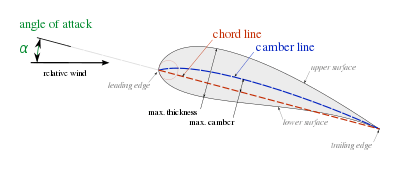
Chord line
An aircraft chord line is a straight line that runs from the leading edge to the trailing edge of an airfoil, such as a wing or tail surface. It is used to measure the width or thickness of the airfoil at any given point. The distance between the leading and trailing edges at that point is called the chord. The chord is an important measurement used in the design of aircraft, as it affects the lift, drag, and stability of the aircraft.
-
Question 5 of 85. QuestionCorrectIncorrect
Runway illusions
Lane widths
Narrow runways: Narrow runways can create the illusion that you are higher than you actually are. This will result in a low approach.Wide runways: Wide runways can create the illusion that you are lower than you actually are. This will result in a high approach.
Runway slopes
Runways with a downward slope: Runways with downward slopes can create the illusion that you are lower than you actually are. This will result in a high approach.
Runways with an upward slope: Runways with upward slopes can create the illusion that you are higher than you actually are. This will result in a low approach.
-
Question 6 of 86. QuestionCorrectIncorrect
Emergency landing in field
If an aircraft experiences an engine failure while in flight and the pilot must make an emergency landing on a harvested field, there are several factors that they should consider:- The condition of the field: The pilot should try to land on a field that is relatively flat and free of debris or other obstacles. If the field is wet or muddy, it may be more difficult for the aircraft to stop after landing.
- The direction of the wind: The pilot should try to land into the wind if possible to help slow the aircraft down.
- The position of the aircraft: The pilot should try to land the aircraft as close to the center of the field as possible, to give themselves the most room to stop.
- The exit plan: After landing, the pilot should try to get themselves and any passengers out of the aircraft as quickly as possible, in case of a fire or other danger.
-
Question 7 of 87. QuestionCorrectIncorrect
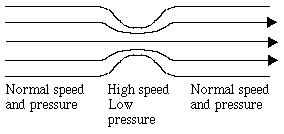
Venturi
The Venturi effect is a phenomenon that occurs when a fluid flows through a constricted area and its velocity increases while its static pressure decreases. This effect is based on the principles of continuity and conservation of mechanical energy. In situations such as a fluid flowing through a tube with a narrow section, the fluid must maintain a constant flow rate, which is achieved by increasing its velocity in the constricted area. This principle can also be observed in urban environments, where wind flowing between buildings can become constricted and its velocity increases, resulting in strong gusts of wind beneath the structures.
 -
Question 8 of 88. QuestionCorrectIncorrect
We start out by finding the fuel usage between the last two points: 175.6-158.2= 17.4
Then we the fuel used by the time flown to get the fuel flow: 17.4÷5= 3.48
Then we times the fuel flow per minutes with time need: 3.48×8=27.8
Then we subtract the fuel use for the distance from the remaining fuel: 158.2-27.4=130.4